
Safety Updates
ADs, SBs, & Safety Notices
-
Search the FAA’s database of Advisory Circulars (ACs).
-
Search the FAA’s database of Airworthiness Directives (ADs).
-
Keep up to date with the latest Bell bulletins and safety notices.
-
An online collection of airworthiness information, including Airworthiness Directives (ADs), Proposed ADs (PADs), and Safety Information Bulletins (SIBs).
-
Enstrom Helicopter Corporation publishes a "Safety Check" series on its blog, covering topics such as winter flying, rotor RPM management, pilot judgment, and preflight procedures.
-
Keep up to date with the latest Robinson safety notices.
-
From the FAA Safety Team - Manufacturers issue aircraft Service Bulletins to inform owners and operators about critical and useful information on aircraft safety, maintenance, or product improvement. Compliance with Service Bulletins may or may not be mandatory, but you should never ignore them when it comes to safety.
-
Search the FAA’s database of Special Airworthiness Information Bulletins (SAIB).
Information Updates
-
After analyzing dozens of helicopter accidents that resulted in fatalities for pilots and passengers, the U.S. Helicopter Safety Team has uncovered six focus areas where flight instructors can improve safety in the helicopter industry. The facts show that failure in these areas has resulted in lives being lost.
-
This Information for Operators (InFO) provides information to helicopter operators, including flight schools and flight training facilities, about bird strike hazards.
-
By Lee Roskop (IHST team member):
If you are a personal/private helicopter operator, the helicopter industry needs your help. We need your help to reduce the fatalities and injuries to those who travel in helicopters each year. We need your help to significantly reduce accidents. We need your help because too many personal/private helicopter operators and aircraft are now accident statistics.
-
From the International Helicopter Safety Team (IHST) - A pilot’s immediate actions after encountering inadvertent IMC usually will determine the outcome of the entire event. Pilots who possess a plan of action prior to encountering it are more likely to experience a successful outcome (staying alive) than those who are less trained and less proficient in the recognition and recovery procedures.
-
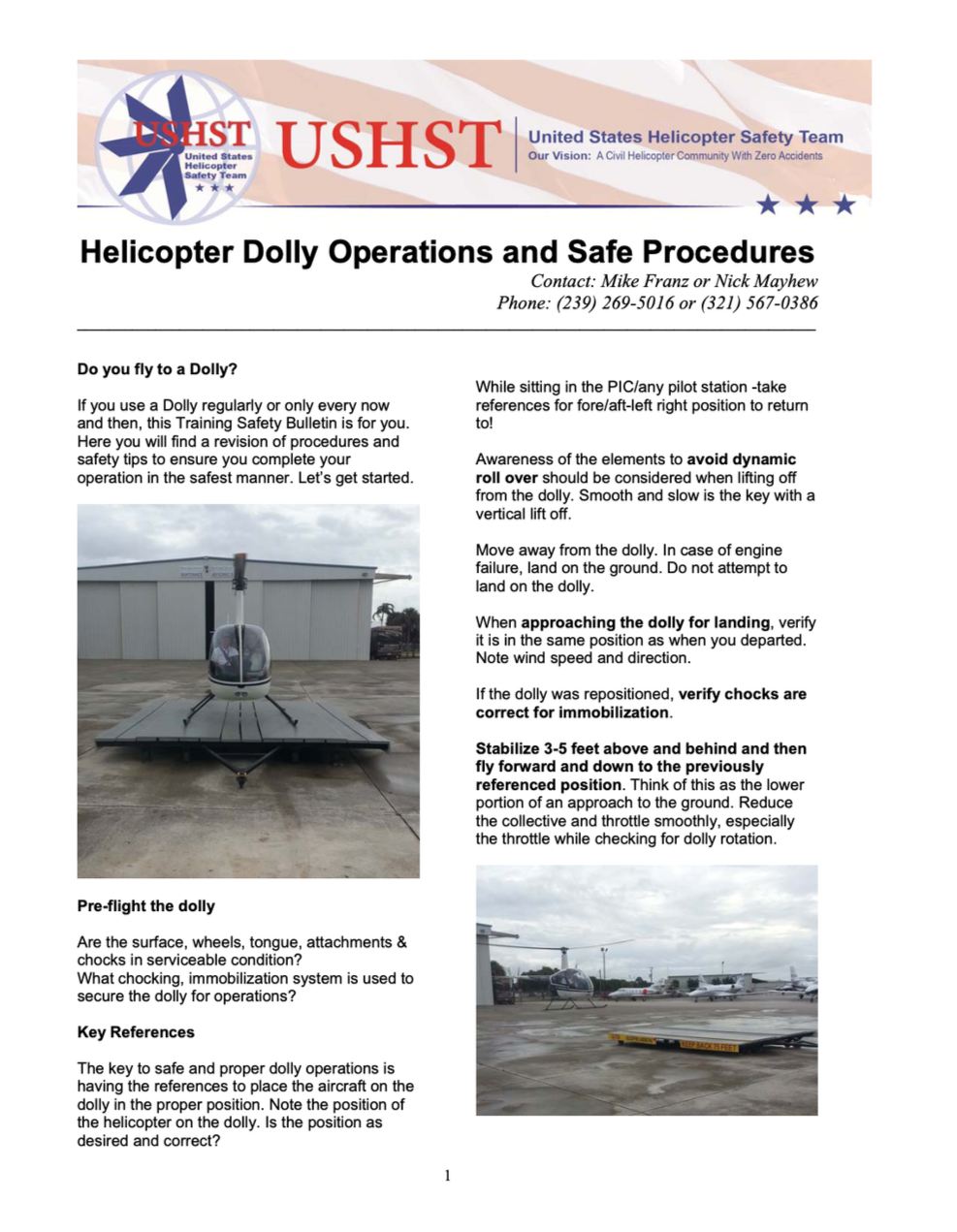
From the US Helicopter Safety Team (USHST) - If you use a Dolly regularly or only every now and then, this Training Safety Bulletin is for you. Here you will find a revision of procedures and safety tips to ensure you complete your operation in the safest manner.
-
The risk and actions of laser strikes on aircraft, from the Federal Aviation Administration and the Civil Aerospace Medical Institute.
-
NTSB Safety Alert 067 - Within fuel-related accidents, fuel exhaustion and fuel starvation continue to be leading causes. Prevent the preventable with careful fuel management.
-
NTSB Safety Alert 057 - Unsecured or improperly secured foreign object debris (FOD) at helicopter landing sites can migrate due to the effects of main rotor system downwash and upwash and foul the main or tail rotor systems.
-
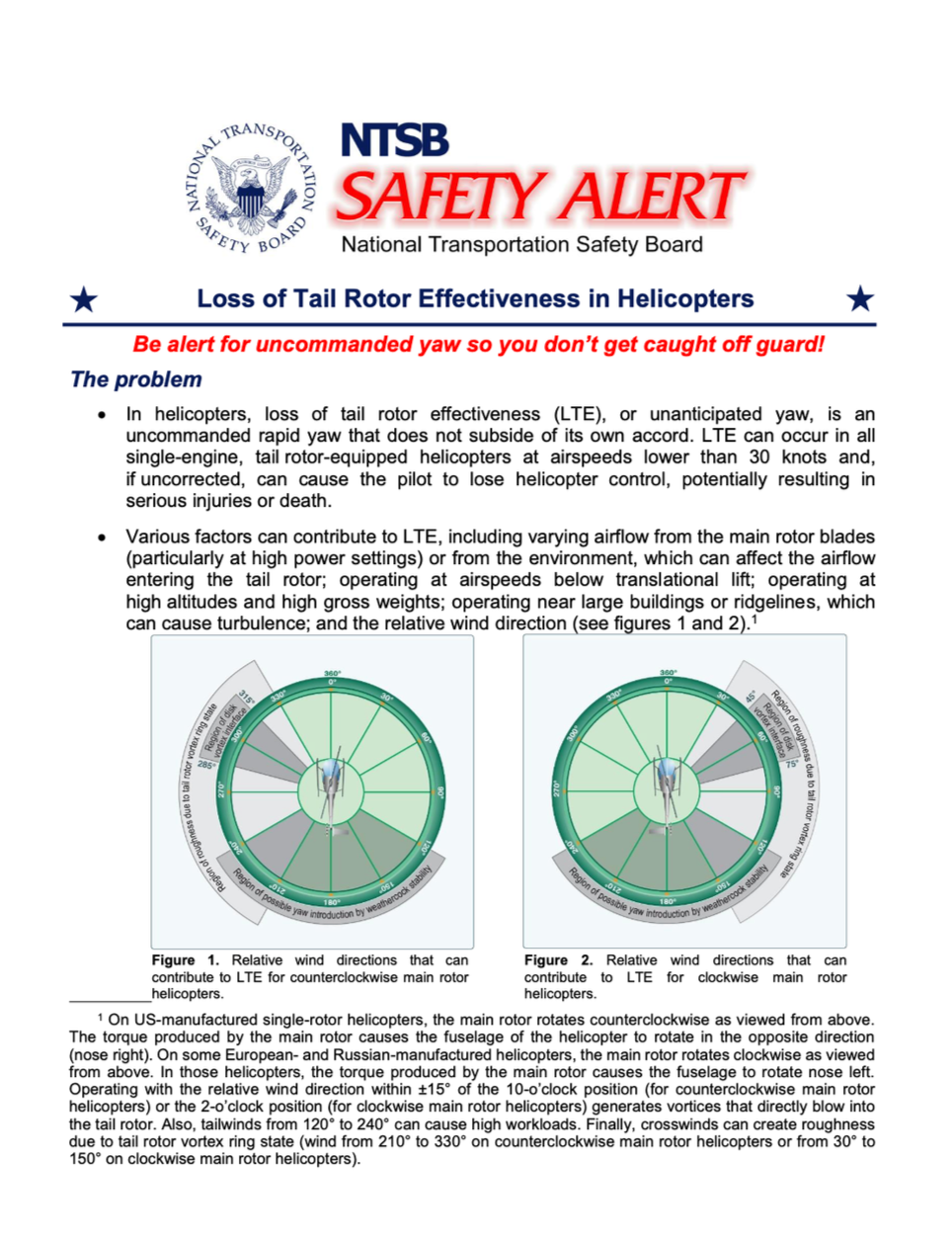
NTSB Safety Alert 062 - Loss of Tail Rotor Effectiveness in Helicopters. Be alert for uncommanded yaw so you don’t get caught off guard!
-
NTSB Safety Alert 031 - Use of simulators can prepare helicopter pilots for emergencies and prevent accidents
-
NTSB Safety Alert 052 - Prevent controlled flight into terrain in flat light and whiteout conditions.
-
Passenger S-A-F-E-T-Y Briefing Card and Checklist, from the FAA Safety Briefing.
-
The Helicopter Association International (HAI) recently launched the “Land and Live” program. The Precautionary Landings Safety Bulletin is designed to support this initiative by offering suggestions on how training sessions can be designed to assist helicopter pilots in making decisions to discontinue a flight when conditions start to deteriorate.
-
A Safety Around Helicopters Poster from the Civil Aviation Authority of New Zealand!
-
This Information for Operators (InFO) serves to recommend Spatial Disorientation (SD) training for Parts 91, 91 subpart K (91K), and 135 operations.
-
Pilots, particularly those with considerable experience, try to complete a flight as planned, please passengers, meet schedules and generally demonstrate the "right stuff." This basic drive can have an adverse effect on safety and can impose an unrealistic assessment of piloting skills under stressful situations. Even worse, repetitive patterns of behavior based on unrealistic assessments can produce piloting practices that are dangerous, often illegal, and will ultimately lead to mishaps. Here are 12 of these possibly dangerous tendencies or behavior patterns.